Plant trailer types explained
Beavertail, tailgate ramp, tilt bed, low loader and drop-side. Five ways of getting a machine onto a deck, each solving a different problem — and each costing you something in payload, deck space or price.
The short version
Beavertail gives the shallowest loading angle and suits low-clearance machines. Tailgate ramp gives the most usable flat deck for the money. Tilt bed removes ramps entirely and is fastest for repeat loading. Low loader drops the deck between the axles for the lowest possible load height. Drop-side adds a general-purpose body over a plant deck.
If you carry one machine, buy for that machine’s clearance. If you carry many, buy the shallowest angle you can afford.

1. Beavertail
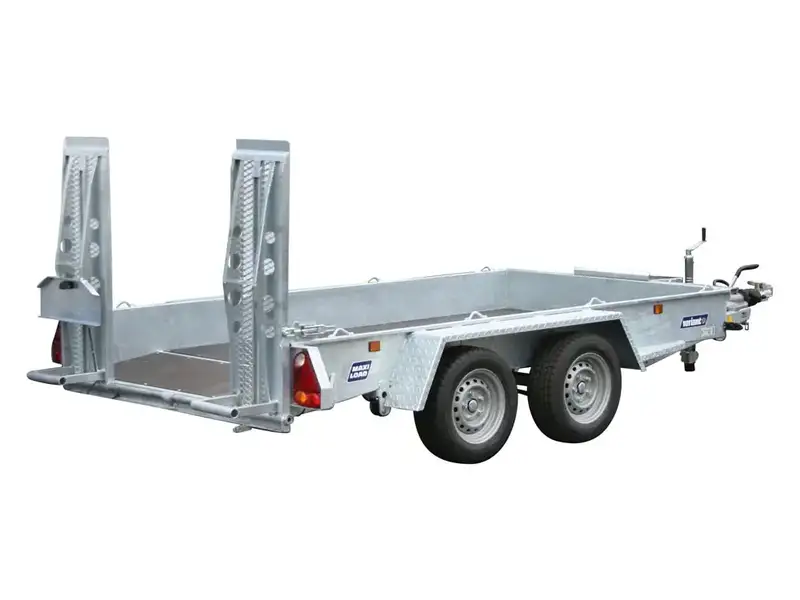
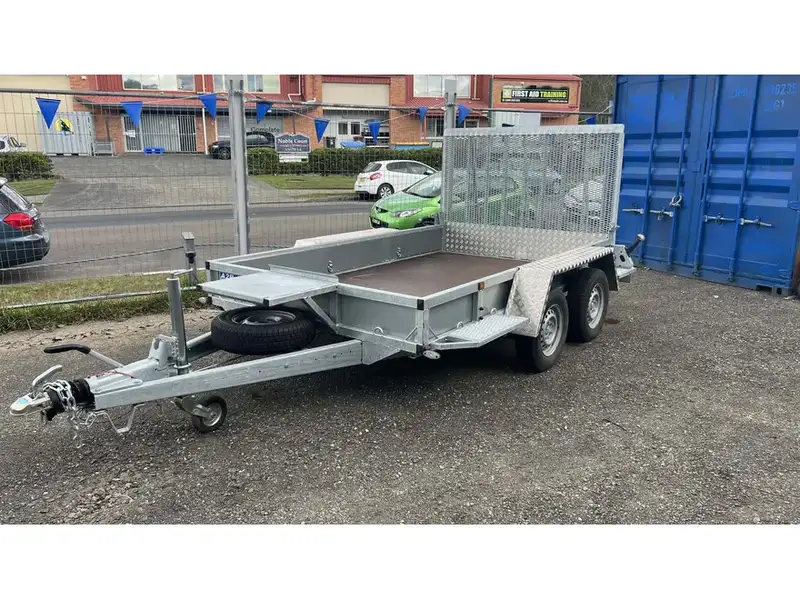


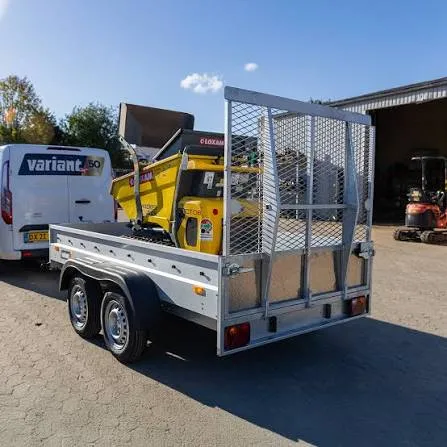
On a beavertail the rear section of the deck is angled downward toward the ground, and short split ramps bridge the last gap. Because the taper is built into the chassis rather than bolted on, the effective loading angle is far shallower than a ramp alone can achieve.
The published Variant 3518 B4 illustrates the point: a 290 mm load height and a 12° ramp angle on a 4.00 × 1.80 m deck.2 The shorter 3516 B3 in the same family, with a 3.00 × 1.62 m deck and a 330 mm load height, comes in at 22°.3 Same design philosophy; the extra metre of trailer is what buys the shallow angle.
Best for: low-clearance machines, scissor lifts, rollers, wheeled machines with small-diameter tyres, and anyone loading on uneven ground where the approach itself adds angle.
The trade-off: the tapered section is not flat deck. A 4 m beavertail gives you less usable level surface than a 4 m flat deck, and long machines can end up with their rear overhanging the taper. Split ramps also weigh more and add tare — the B4’s 785 kg against the B3’s 593 kg.23
2. Tailgate ramp (machine series)
A completely flat deck with a single full-width ramp hinged at the rear, usually gas-strut assisted so one person can raise it. When up it doubles as a tailgate; when down it is the full width of the trailer, which matters more than people expect — a machine that only has to be roughly aligned is far safer to load than one that has to be threaded onto two narrow ramps.
The Variant 3518 M3 publishes a 380 mm load height and a 17° ramp on a 3.00 × 1.80 m deck, with a 730 kg tare leaving 2,770 kg of payload.4 The deck is 180 mm wider than the equivalent beavertail, and all of it is flat.
Best for: mixed loads, tracked machines with reasonable belly clearance, operators who also want to carry pallets, materials or a second small machine on the same deck.
The trade-off: a higher deck and a steeper angle than a beavertail of the same length. A full-width ramp is also heavy and, on cheaper trailers, prone to twisting under a track edge.
3. Tilt bed
The entire deck pivots on a central hinge so the rear touches the ground. Gravity tilt beds are released by a latch and controlled by a damper; hydraulic tilt beds are pumped. There are no ramps to store, lose, or lift.
Best for: hire fleets and operators loading and unloading many times a day, and for machines that are awkward to align with separate ramps. The angle at the transition point is a single continuous slope, which suits long-wheelbase machines that would bottom out at a ramp-to-deck junction.
The trade-off: more moving parts and more to maintain, higher tare for the same capacity, and the load must be positioned to let the deck return level. Tilt decks are also less convenient for part-loads because you cannot leave the machine anywhere except where the balance allows.
4. Low loader / drop deck
The deck is dropped between the axles rather than sitting above them, producing the lowest load height available under 3.5 tonnes. Where a conventional plant trailer sits at 330–380 mm, a low loader brings the working deck materially closer to the ground — which shortens every ramp on the trailer.
Best for: tall machines that would otherwise exceed height limits, very low-clearance equipment, and anywhere ramp angle is the binding constraint.
The trade-off: the dropped section restricts wheel travel and suspension design, usually costs payload, and the wheel arches intrude into the deck width. Expect to pay more per kilogram of capacity.
5. Drop-side plant body
A plant-rated deck and ramp system with removable or hinged sides. Sides up, it is a tipper-style body for spoil, rubble or materials; sides down, it is a plant deck. Popular with landscapers and small civil operators who need one trailer to do two jobs.
Best for: operators alternating between carrying a mini loader and carrying loose material.
The trade-off: the sides are tare weight you carry whether you need them or not, and the compromise deck is rarely as low or as long as a dedicated plant trailer. If you carry material more than machinery, a dedicated tipper is the better tool — see tippertrailer.au.
6. Car-plant combination
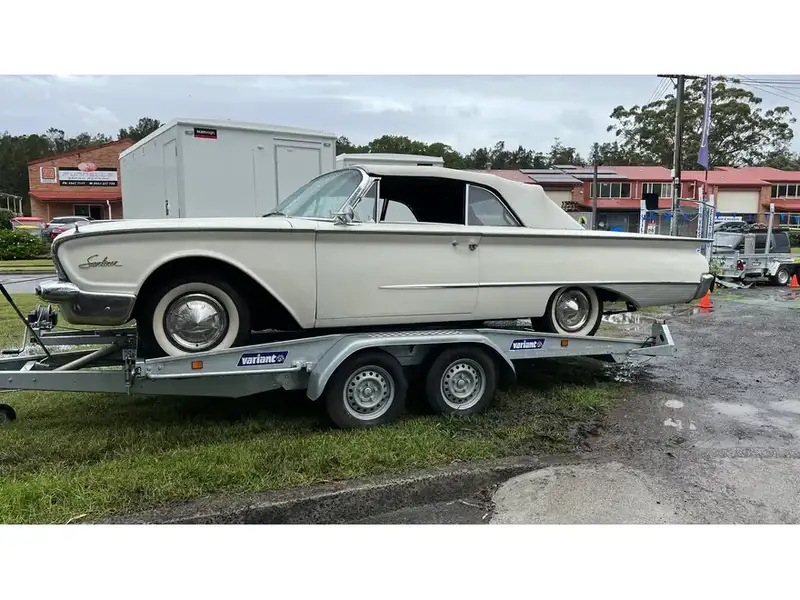
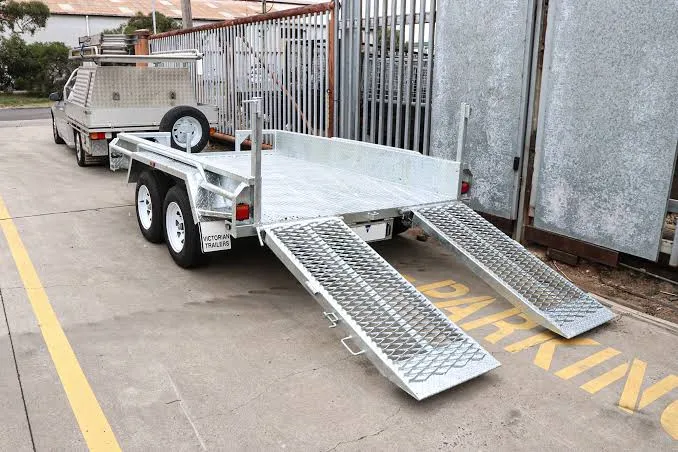
A flat deck with slide-out ramps and a winch, rated for both a vehicle and light plant. Genuinely useful if you move both, but be careful: a deck engineered for a car’s four evenly spaced contact patches is not automatically rated for an excavator’s tracks concentrating 2.5 tonnes over a small area. Check the deck’s point-load rating, not just the ATM.
| Type | Typical load height | Typical angle | Flat deck | Tare penalty | Best for |
|---|---|---|---|---|---|
| Beavertail | 290–330 mm | 12–22° | Reduced by taper | Moderate | Low-clearance machines |
| Tailgate ramp | ~380 mm | ~17° | Full | Moderate | Mixed loads, best deck value |
| Tilt bed | Similar to flat deck | Continuous slope | Full | Higher | High-frequency loading |
| Low loader | Lowest available | Lowest available | Narrowed by arches | Higher | Tall or very low machines |
| Drop-side | Higher | Steeper | Full, with sides | Highest | Machinery plus material |
Load height, angle and tare figures for the beavertail and tailgate rows are published manufacturer specifications for the Variant 3516 B3, 3518 B4 and 3518 M3.234 Other rows describe the general characteristics of each design and vary widely between builders.
Which one should you buy?
Work in this order.
1. Measure your machine’s belly clearance and wheelbase or track length. That determines the maximum ramp angle you can use without grounding out. Anything under about 200 mm of clearance pushes you toward a beavertail or low loader.
2. Weigh the machine as you tow it — with the bucket, attachments, full fuel and any toolbox. That number must sit under the trailer’s payload with margin.
3. Measure the machine’s track width and add 150 mm each side. That is your minimum deck width.
4. Only then compare prices. A cheaper trailer your machine cannot climb is not cheaper.
Frequently asked questions
What does beavertail mean on a trailer?
A beavertail is a rear deck section that slopes downward toward the ground, so the trailer's own chassis forms most of the loading ramp. Short split ramps bridge the final gap. Because the taper is structural rather than bolted on, beavertails achieve much shallower loading angles — as low as 12° on a 4 m deck — than a flat trailer with ramps.
Is a tilt bed better than ramps for a mini excavator?
For frequent loading, yes: there is nothing to unfold, lift or store, and the single continuous slope avoids the ramp-to-deck transition where long machines ground out. For occasional use a beavertail or tailgate ramp is simpler, lighter and cheaper, and gives you a flat deck you can also use for other loads.
What is the lowest loading angle available on a plant trailer under 3.5t?
Around 12° on a long beavertail. The published Variant 3518 B4 — a 4.00 × 1.80 m deck with a 290 mm load height — is specified at 12°. Shorter beavertails on the same platform sit closer to 22°, and flat-deck trailers with a tailgate ramp are typically 17–20°.
Can a plant trailer carry a car as well as machinery?
Usually yes, but check the deck's point-load rating and the wheel track. Plant decks are built for concentrated loads under tracks, so a car is easy for the structure; the practical issues are deck width for the car's track, the ramp spacing for the tyres, and whether the ramp angle clears a low front bumper. A car-plant combination trailer with slide-out ramps and a winch handles both better.
How much deck length do I need?
Measure the machine's overall transport length and add at least 300 mm. A Kubota U27-4 is 4,100 mm long with the boom in the transport position, which does not fit a 3.0 m deck without overhang — you need the 4 m deck. Overhang beyond the rear of the trailer is legal within limits but changes weight distribution and tow ball mass, so treat it as a last resort rather than a plan.
Do I need a full-width ramp or are split ramps enough?
Split ramps are lighter and let you set them to the machine's exact track width, which is why beavertails use them. A full-width ramp is more forgiving to load onto, doubles as a tailgate, and supports machines with unusual track spacing. If you load in poor light, on slopes, or with different machines, the full-width ramp is the safer choice.
Sources and further reading
- Plant & Machinery Trailers range, Variant Trailers Australia — variant-trailers.com.au/category/trailers/plant-machinery-trailers/
- Beavertail Trailer 3518 B4 specification, Variant Trailers Australia — variant-trailers.com.au/trailers/beavertail-trailer-3518b4-4-08x1-88m/
- Beavertail machine trailer 3516 B3 specification, A2B Trailers — www.a2btrailers.com.au/trailers/3516b3/
- Tandem plant trailer 3518 M3 specification, A2B Trailers — www.a2btrailers.com.au/trailers/3518m3/
- Vehicle Standards Bulletin 1 (Revision 6) — Trailers with an Aggregate Trailer Mass of 4.5 tonnes or less, September 2024, Australian Government Department of Infrastructure — www.infrastructure.gov.au/sites/default/files/documents/vsb1-revision-6-traile
- Light Trailer Requirements — Compliance with VSB1, Department of State Growth Tasmania — www.transport.tas.gov.au/?a=109707
- Mini Excavator Weight, Size and Dimensions Guide, DOZR — dozr.com/blog/mini-excavator-spec-guide
- Genie GS-2632 E-Drive scissor lift specifications, Genie — www.genielift.com/en/aerial-lifts/Slab-scissor-lifts/gs2632
Figures were checked against the sources above on 2026-08-26. Manufacturer specifications change without notice — confirm weights and dimensions against the current compliance plate and specification sheet before towing.