Australian towing law for plant trailers
ATM, GTM, tare and tow ball mass in plain English — plus licence requirements, couplings, safety chains and the standards that apply to every trailer under 3.5 tonnes.
The short answer
A standard Australian car licence lets you tow a trailer up to 4.5 tonnes ATM, so a 3,500 kg plant trailer needs no special licence. What limits you instead is your tow vehicle’s braked towing capacity, its maximum tow ball download, and the combination’s GCM — all three set by the vehicle manufacturer, and all three enforceable.
Get the trailer’s compliance plate out and read the ATM and GTM figures. Everything else follows from those two numbers.
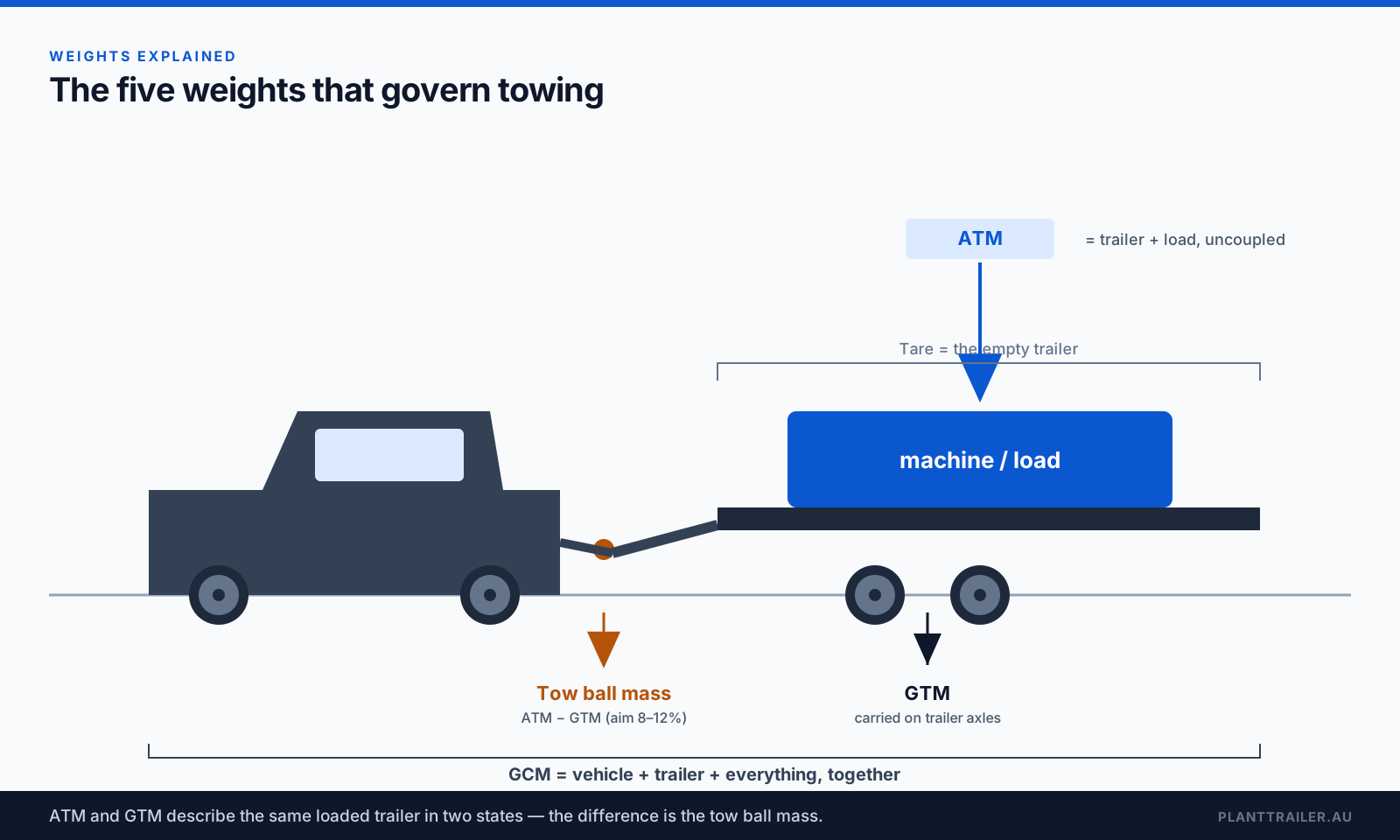
The weight terms, defined
| Term | What it means | Where you find it |
|---|---|---|
| Tare | The unladen weight of the trailer itself, empty.3 | Compliance plate; verify on a weighbridge |
| ATM Aggregate Trailer Mass | The combined weight of the trailer and its full load when not coupled to a tow vehicle.3 | Trailer compliance plate |
| GTM Gross Trailer Mass | The weight of the fully loaded trailer carried on the trailer’s own axles while coupled.3 | Trailer compliance plate |
| Tow ball mass | The downward force the coupled trailer applies to the tow ball. ATM minus GTM. | Ball weight scale |
| Payload | ATM minus tare — what you can actually put on the deck. | Calculate it yourself |
| GVM Gross Vehicle Mass | Maximum loaded weight of the tow vehicle alone.3 | Vehicle placard |
| GCM Gross Combination Mass | Maximum allowable weight of the tow vehicle and trailer together, loads and passengers included.3 | Vehicle handbook |
ATM vs GTM: the one that trips people up
ATM and GTM describe the same loaded trailer in two different states. ATM is what it weighs standing on its own with the jockey wheel down. GTM is what its axles carry once it is coupled, because some of the weight has transferred forward onto the tow ball. GTM is therefore always lower than ATM, and the difference is the tow ball mass.3
This matters because different rules use different figures. Braking requirements are expressed in GTM — brakes on all wheels and a breakaway system above 2,000 kg GTM.2 Coupling and chain standards are expressed in ATM — AS 4177 chains and a quick-release positive-locking coupling up to 3,500 kg ATM.1 Reading the wrong number leads people to buy the wrong equipment.
Worked example. A trailer with a 3,500 kg ATM and a 3,150 kg GTM has a designed tow ball mass of 350 kg — exactly 10% of ATM. Load a 2,570 kg excavator onto a 785 kg tare trailer and you are at 3,355 kg ATM, comfortably under the plate. But if you park that machine too far back, the ball mass could drop to 150 kg — still under every plated limit, and still an unstable, sway-prone combination. Compliance and safety are not the same test.
Tow ball mass
Vehicle manufacturers publish a maximum tow ball download, and it is commonly around 10% of the vehicle’s maximum towing capacity — though it varies, with some as low as 5% and some higher.3 Treat 8–12% of the loaded trailer mass as the target range and the vehicle’s stated maximum as an absolute ceiling.
Three things follow that people routinely miss:
- Tow ball mass counts toward the tow vehicle’s GVM. A 350 kg download is 350 kg of the ute’s payload gone before you put a single tool in the tray.
- It loads the rear axle disproportionately. Because the ball sits behind the rear axle, the download levers weight off the front axle. That is what degrades steering feel and braking on an overloaded combination.
- It changes with machine position, not just machine weight. Moving a 2.5 tonne machine 300 mm along the deck moves a surprising amount of mass on and off the ball.
What your tow vehicle can actually pull
Four independent limits apply at once, and you must satisfy every one of them:
- Maximum braked towing capacity — the trailer’s ATM must not exceed it. A 3,500 kg rated vehicle can tow a 3,500 kg ATM trailer; a 2,500 kg rated vehicle cannot, whatever the trailer’s plate says.
- Maximum tow ball download — separate figure, separately enforced.
- GVM of the tow vehicle — including passengers, tools, canopy, fuel and the ball download.
- GCM of the combination — and this is the one that catches people. Many vehicles rated to tow 3,500 kg cannot legally do so at full GVM, because GCM is less than GVM plus maximum tow capacity. You have to give up payload in the vehicle to use the full towing capacity.
Licence requirements
A standard Australian car licence (class C) permits towing a trailer up to 4.5 tonnes ATM, so no additional licence class is needed for any plant trailer under 3.5 tonnes.56 There are, however, practical constraints worth knowing:
- Learner and provisional drivers face towing restrictions in some states. Check your state authority.
- Work health and safety obligations still apply even where the licence does not restrict you. If you are towing for an employer, competency and load restraint training are usually required regardless of licence class.
- Above 4.5 tonnes ATM you move into heavy vehicle territory: a light rigid or medium rigid licence, and heavy vehicle national law obligations including chain of responsibility.
Couplings, chains, lights and plates


- Coupling. Trailers up to 3,500 kg ATM require a quick-release coupling of a positive locking type with provision for a second independent locking device.1
- Safety chains. AS 4177 (1994 or 2004) for trailers up to 3,500 kg ATM. Above 3,500 kg the standard changes to AS 2321.1 Cross them beneath the drawbar and keep them short enough that the drawbar cannot touch the road.
- Breakaway system. Required above 2,000 kg GTM, and must apply the trailer brakes automatically if the trailer detaches.2
- Lights and reflectors. Tail, stop, indicator, number plate light and rear reflectors are all mandatory, and on a plant trailer they live in the worst possible environment. Sealed LED clusters are worth the money.
- Compliance plate. Every trailer must carry one showing its ATM and other ratings. No plate, no legal registration — and no way to prove what you are allowed to load.
State differences
The construction standards in VSB1 and the Australian Design Rules are national, so the trailer itself is built to one set of rules everywhere.1 What varies between states is registration procedure, inspection requirements, provisional-licence towing restrictions, and in some jurisdictions towing speed limits. Before a long interstate move, check the authority for each state you will pass through — the requirements travel with the road, not with your registration.
Authoritative starting points: Queensland, South Australia and Tasmania all publish clear light-trailer guidance.256
Five myths worth killing
“My ute is rated to 3,500 kg so I can tow 3,500 kg.” Only if GCM allows it at your actual vehicle load. Check GCM before you trust the tow rating.
“The trailer is under ATM so I’m fine.” ATM is one of four limits. Ball mass, GVM and GCM apply simultaneously.
“I need a special licence for a 3.5 tonne trailer.” You do not. A car licence covers up to 4.5 tonnes ATM.
“Overrun brakes aren’t legal here.” They are, up to 3,500 kg ATM, and require no in-cab controller.4
“The dealer told me it fits.” The compliance plate and a weighbridge ticket are evidence. A conversation is not.
Frequently asked questions
Do I need a special licence to tow a 3.5 tonne plant trailer in Australia?
No. A standard car licence permits towing a trailer up to 4.5 tonnes ATM, so a 3,500 kg plant trailer is covered. What limits you is the tow vehicle's braked towing capacity, its maximum tow ball download, and the combination's GCM. Learner and provisional drivers face restrictions in some states.
What is the difference between ATM and GTM?
ATM is the total weight of the loaded trailer standing on its own, uncoupled. GTM is the weight carried on the trailer's own axles once it is coupled, because some weight has transferred to the tow ball. GTM is always lower, and the difference is the tow ball mass. Brake requirements are set by GTM; coupling and chain standards are set by ATM.
How do I work out a plant trailer's payload?
Payload equals ATM minus tare. A trailer plated at 3,500 kg ATM with a 785 kg tare gives 2,715 kg of payload. Use the compliance plate figure rather than the brochure, and remember payload includes the machine, its attachments, full fuel, chains and anything else on the deck.
Can I tow 3,500 kg with a vehicle rated to tow 3,500 kg?
Not always. Many vehicles have a GCM lower than their GVM plus maximum towing capacity, which means you can only reach full tow capacity by giving up payload in the vehicle itself. Check the GCM figure in the handbook, subtract the loaded vehicle weight including the tow ball download, and what remains is your real towing allowance.
Does tow ball weight count toward my vehicle's payload?
Yes. The download from the coupling is carried by the tow vehicle and counts toward its GVM. A 350 kg ball weight consumes 350 kg of the vehicle's payload before you load any tools, passengers or fuel. It also sits behind the rear axle, so it levers weight off the front axle.
What safety chain standard applies to a plant trailer?
AS 4177 (1994 or 2004) applies to trailers up to 3,500 kg ATM. Above 3,500 kg ATM the standard becomes AS 2321. Chains must be crossed beneath the drawbar and short enough that the drawbar cannot reach the road if the coupling releases.
Is a breakaway system required on a plant trailer?
Yes. Any trailer over 2,000 kg GTM must have brakes on all wheels plus a breakaway system that applies those brakes automatically if the trailer separates from the tow vehicle. Every plant trailer exceeds that threshold, so a breakaway is mandatory, not an option.
Sources and further reading
- Vehicle Standards Bulletin 1 (Revision 6) — Trailers with an Aggregate Trailer Mass of 4.5 tonnes or less, September 2024, Australian Government Department of Infrastructure — www.infrastructure.gov.au/sites/default/files/documents/vsb1-revision-6-traile
- Light Trailer Requirements — Compliance with VSB1, Department of State Growth Tasmania — www.transport.tas.gov.au/?a=109707
- Trailer and Tow Vehicle Specifications, RACQ — www.racq.com.au/car/towing/trailer-and-tow-vehicle-specifications
- Trailer brakes: electric versus quality mechanical overrun, A2B Trailers — www.a2btrailers.com.au/electric-vs-mechanical-trailer-brakes/
- Towing equipment requirements, Queensland Government — www.qld.gov.au/transport/vehicle-safety/towing/towing-equipment
- Light vehicle towing and trailer regulations, Government of South Australia — www.sa.gov.au/topics/driving-and-transport/vehicles/vehicle-standards-and-modi
- Loading Guide — Performance Standards, National Heavy Vehicle Regulator — www.nhvr.gov.au/road-access/loading/loading-guides/performance-standards
- Load Restraint Guide 2018 for Light Vehicles, National Transport Commission — www.ntc.gov.au/sites/default/files/assets/files/NTC%20Load%20Restraint%20Guide
Figures were checked against the sources above on 2026-08-26. Manufacturer specifications change without notice — confirm weights and dimensions against the current compliance plate and specification sheet before towing.