Axles, brakes and couplings: plant trailer running gear
What the law requires at each mass band, how mechanical overrun braking actually works, why European plant trailers use Knott and AL-KO components, and how to tell a well-specified trailer from a cheap one underneath.
The braking rules in one paragraph
A trailer up to 750 kg GTM needs no brakes. Above 750 kg and up to 2,000 kg GTM it needs brakes on at least one axle, and those may be an overrun system. Above 2,000 kg GTM it needs brakes on all wheels, plus a breakaway system that applies the brakes automatically if the trailer separates from the tow vehicle.1
Every plant trailer is in the top band. All-wheel brakes and a breakaway are not optional extras.


What the law requires at each mass band
| Trailer GTM | Brakes required | Breakaway required | Typical trailer |
|---|---|---|---|
| Up to 750 kg | None | No | Box trailer, small tipper |
| 750–2,000 kg | At least one axle; overrun permitted | No | Larger box, small car trailer |
| Over 2,000 kg | All wheels | Yes | Every plant trailer |
Requirements as set out in the national light trailer standards and summarised by state transport authorities.12 Note that these thresholds are expressed in GTM — the mass on the trailer’s own axles when coupled — not ATM. See the weights explained.
Two further requirements apply to any trailer up to 3,500 kg ATM: the coupling must be a quick-release, positive-locking type with provision for a second independent locking device, and safety chains must comply with AS 4177. Above 3,500 kg ATM the chain standard changes to AS 2321.1
How mechanical overrun braking works
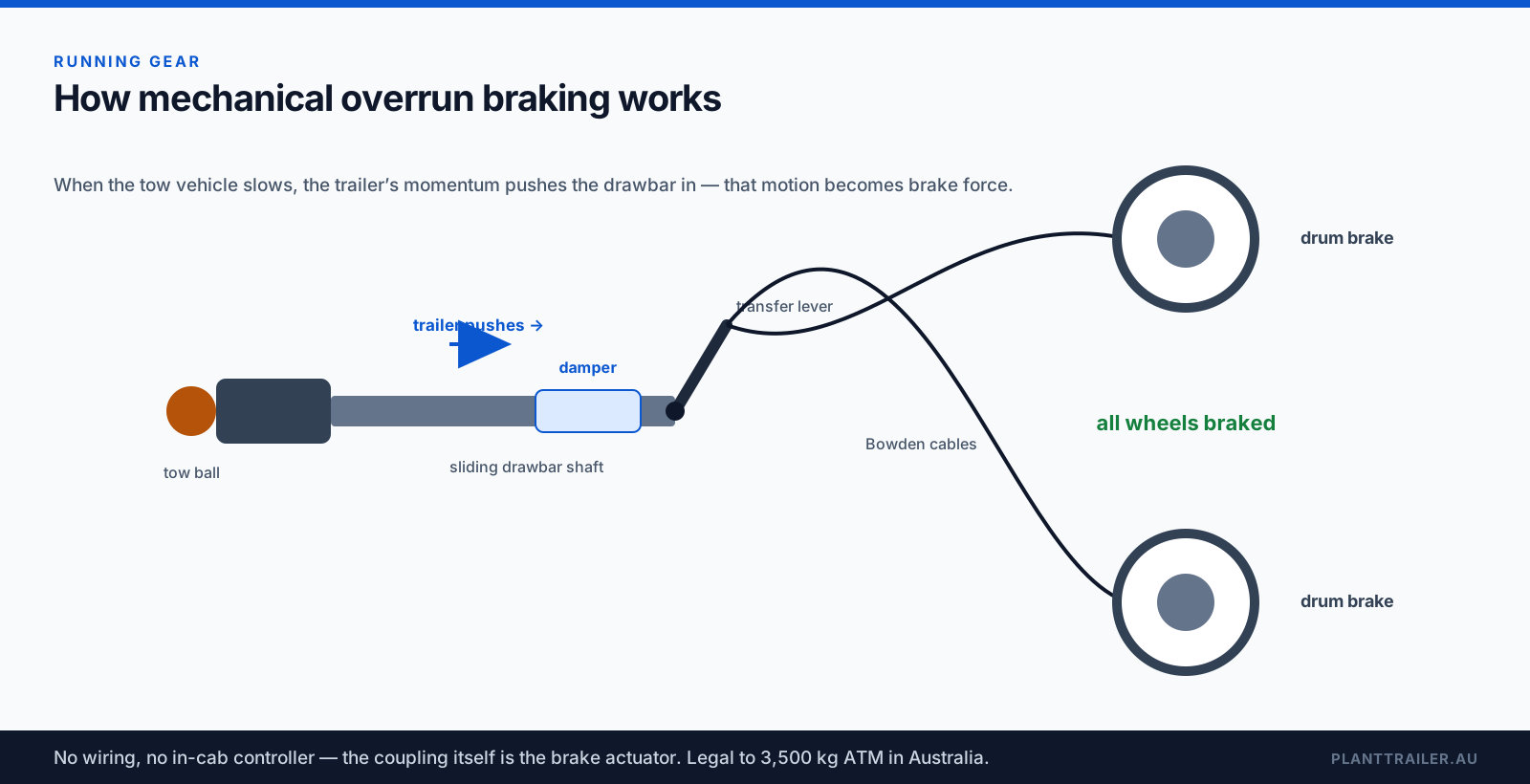
An overrun — or inertia — brake needs no electricity and no driver input. The drawbar is not a solid bar: it slides within the A-frame against a damper. When the tow vehicle slows, the trailer’s momentum pushes the drawbar shaft inward. That movement drives a transfer lever, which pulls Bowden cables to the drum brakes on every wheel. The harder the trailer pushes, the harder it brakes — proportional braking, generated by the physics of the situation rather than by a controller trying to estimate it.5
Two components make the difference between a good system and a crude one. The damper is a shock absorber inside the drawbar; without it, every gear change produces a snatch as the brakes grab and release. Quality European couplings damp this out so the system applies smoothly.4 The auto-reverse mechanism lets the shoes swing away when the drum turns backward, so you can reverse up a driveway without the brakes locking on.45
Why it matters on a plant trailer. You reverse a plant trailer constantly — onto sites, into yards, up ramps. Auto-reverse is the feature you use twenty times a day and never think about. A system without it, or with a worn mechanism, will fight you every time.
Overrun versus electric brakes
This is the clearest dividing line between European and Australian trailer design, and both sides have a real case.
| Mechanical overrun | Electric | |
|---|---|---|
| In-cab controller | Not required4 | Required, and must be calibrated |
| Wiring | Lighting circuit only | Lighting plus brake circuit |
| Common failure | Worn damper, seized cables | Connector corrosion, controller faults |
| Reversing | Auto-reverse mechanism | Controller cuts brakes |
| Driver control | None — fully automatic | Manual gain, manual override on descents |
| Legal ceiling | 3,500 kg ATM4 | No practical ceiling |
| Swap between tow vehicles | Hitch and go | Needs a controller in each vehicle |
The case for overrun: nothing to wire, nothing to calibrate, no connector to corrode, and any vehicle with a tow bar can tow it. For a trailer that gets hitched to whatever ute is free that morning, that is a practical advantage every single day.4
The case for electric: a manual gain control lets you dial in more trailer braking on long descents and reduce sway, and it takes load off the tow vehicle’s brakes in a way an overrun system cannot. Above 3,500 kg you have no choice anyway.
The honest summary: under 3.5 tonnes, a well-maintained overrun system with a good damper and working auto-reverse is entirely adequate and considerably simpler. Neglected, it is worse than electric, because the failure is gradual and silent rather than an obvious dashboard fault.
Axles and suspension
Under a plant trailer you will find one of two suspension philosophies.
Parabolic leaf springs — tapered multi-leaf packs, as fitted to the Variant plant range.678 They are progressive, tolerant of overload, cheap to replace anywhere in Australia, and easy to inspect: if a leaf is cracked you can see it. They also flex, which is exactly what you want when a track edge lands on one wheel.
Rubber torsion axles — rubber cords compressed inside a square axle tube. Independent per wheel, no moving parts to grease, very low unsprung weight, and no springs to sag. The downsides are that the rubber degrades with UV and age, they are harsher when unladen, and when they do fail the whole axle is replaced.
Either is fine on a quality build. What matters more is whether the axle is rated above the trailer’s GTM with margin, and whether the bearings are sealed. Plant trailers get reversed into mud and launched down site tracks; an open bearing packed with grease and hope is the component that will strand you.
Couplings, chains and breakaway
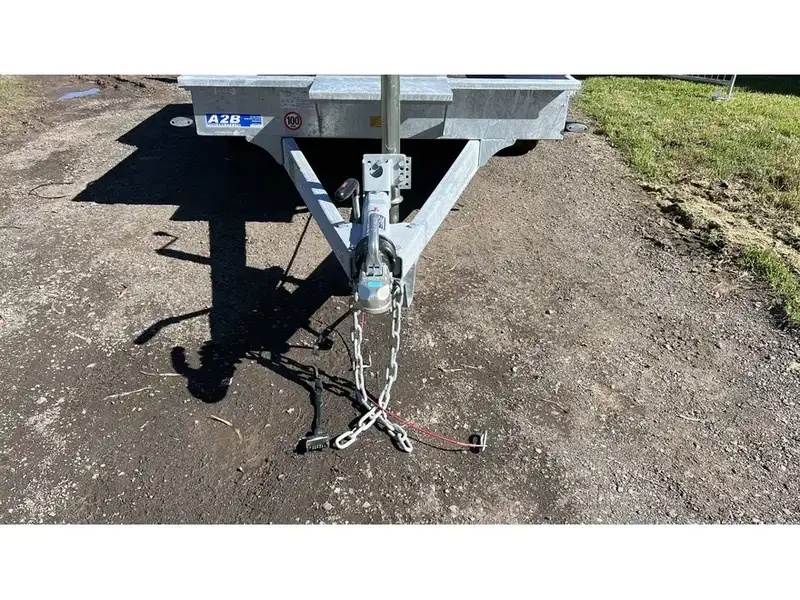
- Coupling. Up to 3,500 kg ATM it must be quick-release, positive-locking, with provision for a second independent locking device.1 On an overrun trailer the coupling is also the brake actuator — so it carries a handbrake lever and a damper, and it is a serviceable assembly, not just a latch.
- Safety chains. Rated to AS 4177 for trailers to 3,500 kg ATM.1 Cross them under the drawbar so that if the coupling releases, the drawbar lands in the cradle they form rather than digging into the road.
- Breakaway. Mandatory over 2,000 kg GTM.1 On a mechanical system it is a cable that pulls the handbrake fully on if the trailer detaches. Attach it to a dedicated point on the tow bar — never to the safety chain, and never to the ball itself, because if the ball goes the cable goes with it.
Wheels, tyres and bearings
Plant trailers run relatively small wheels — 12 inch and 13 inch, typically five-stud, on the published Variant plant range.678 Small wheels keep the deck low, which is the whole point, but they turn faster and run hotter than a car wheel at the same road speed. That puts real load on tyres and bearings.
- Load index matters more than tread. A tyre with plenty of tread and an inadequate load rating is the wrong tyre. Check the index against the axle rating, not against the trailer’s empty weight.
- Pressure is not optional. Trailer tyres almost always run near their maximum rated pressure when loaded. Underinflated small tyres build heat quickly.
- Age kills trailer tyres before tread does. A trailer that does 4,000 km a year will fail on sidewall cracking long before it wears out. Read the four-digit date code.
- Carry a spare that matches. The published Variant plant specifications include a fifth wheel as a spare on some models — confirm yours has one, and that it is the same stud pattern and rating.68
Maintenance that actually matters
| Interval | Check | Why |
|---|---|---|
| Every load | Coupling latched and secondary device engaged; chains crossed; breakaway attached; lights working; tyre pressures | The failures that cause crashes are almost all here |
| Monthly | Damper action (push the drawbar in by hand — it should resist and return smoothly); handbrake holds on a slope | A dead damper makes braking snatchy and is easy to miss |
| Every 5,000 km or 6 months | Brake shoe wear and adjustment; cable free movement; wheel nut torque | Overrun brakes need adjustment as shoes wear or braking gradually fades |
| Annually | Bearings inspected or repacked; suspension bushes and springs; deck fixings; lashing point condition | Cheap, and the alternative is a bearing failure on the highway |
| After any wet or muddy site work | Hose the running gear, then check brakes hold | Grit in the drums is what wears them out |
The one-minute test that finds most problems. With the trailer coupled and the handbrake off, push hard backward on the drawbar by hand. You should feel the damper compress smoothly, resist, and return. If it slides in freely with no resistance, the damper is dead and the brakes are snatching. If it will not move at all, the cables or shoes are seized. Either way you have found it in the yard rather than on a descent.
Frequently asked questions
At what weight does a trailer need brakes in Australia?
Over 750 kg GTM a trailer needs brakes on at least one axle, and those may be an overrun system. Over 2,000 kg GTM it needs brakes on all wheels plus a breakaway system that applies the brakes if the trailer separates. All plant trailers fall in the top band, so all-wheel brakes and a breakaway are mandatory.
Do I need a brake controller for an overrun braked trailer?
No. Overrun braking is entirely mechanical — the trailer's own momentum pushing on the sliding drawbar generates the brake force, so there is nothing to wire into the tow vehicle and nothing to calibrate. That is why an overrun trailer can be hitched to any vehicle with a tow bar and towed immediately.
What is auto-reverse on a trailer brake?
A mechanism inside the drum brake that lets the shoes swing clear when the drum rotates backward, so the brakes do not lock on when you reverse. Without it, backing a heavy overrun trailer up any slope is close to impossible. All quality European overrun systems include it; check that yours still works by reversing up a gentle rise.
Are overrun brakes as good as electric brakes?
Under 3,500 kg, a well-maintained overrun system is entirely adequate and considerably simpler — no controller, no brake wiring, no calibration, and it works behind any tow vehicle. Electric brakes give you manual gain control on long descents and take more load off the tow vehicle's brakes. Above 3,500 kg ATM overrun is no longer permitted.
Where should the breakaway cable attach?
To a dedicated attachment point on the tow bar, separate from the safety chains and separate from the ball. If you loop it over the ball and the ball fails, the cable comes away with it and the breakaway never operates. If you attach it to a safety chain, chain movement can trigger it in normal towing.
Parabolic leaf springs or rubber torsion axles — which is better?
Both work well. Parabolic leaves are progressive, tolerant of overload, visibly inspectable and replaceable anywhere in Australia. Rubber torsion axles are independent per wheel, need no greasing and have very low unsprung weight, but degrade with age and UV and are replaced as a complete unit. Axle rating and sealed bearings matter more than which type you choose.
How often should trailer brakes be adjusted?
Every 5,000 km or six months, whichever comes first, and sooner if you notice the drawbar travelling further before the brakes bite. Overrun brakes lose effectiveness gradually as the shoes wear, and because the loss is progressive most owners do not notice until the trailer is pushing the tow vehicle at every set of lights.
Sources and further reading
- Light Trailer Requirements — Compliance with VSB1, Department of State Growth Tasmania — www.transport.tas.gov.au/?a=109707
- Vehicle Standards Bulletin 1 (Revision 6) — Trailers with an Aggregate Trailer Mass of 4.5 tonnes or less, September 2024, Australian Government Department of Infrastructure — www.infrastructure.gov.au/sites/default/files/documents/vsb1-revision-6-traile
- A Guide to Trailer Brakes, RACQ — www.racq.com.au/articles/driving-tips/a-guide-to-trailer-brakes
- Trailer brakes: electric versus quality mechanical overrun, A2B Trailers — www.a2btrailers.com.au/electric-vs-mechanical-trailer-brakes/
- Overrun brake — mechanism and operation — en.wikipedia.org/wiki/Overrun_brake
- Beavertail Trailer 3518 B4 specification, Variant Trailers Australia — variant-trailers.com.au/trailers/beavertail-trailer-3518b4-4-08x1-88m/
- Beavertail machine trailer 3516 B3 specification, A2B Trailers — www.a2btrailers.com.au/trailers/3516b3/
- Tandem plant trailer 3518 M3 specification, A2B Trailers — www.a2btrailers.com.au/trailers/3518m3/
- Towing equipment requirements, Queensland Government — www.qld.gov.au/transport/vehicle-safety/towing/towing-equipment
Figures were checked against the sources above on 2026-08-26. Manufacturer specifications change without notice — confirm weights and dimensions against the current compliance plate and specification sheet before towing.