Buying a plant trailer: European vs Australian
Where the two build philosophies genuinely differ, what to inspect before you hand over money, and the questions that separate a trailer that will still be working in fifteen years from one that will not.

The real difference, in one idea
European plant trailers are engineered around maximising payload inside a fixed 3,500 kg limit. Australian plant trailers are more often engineered around surviving rough use and being repairable anywhere. Neither is wrong — they are answers to different questions.
If your machine is close to the payload ceiling, or you load on tight sites, the European approach wins on numbers. If you run remote, tow on unsealed roads, and want anything fixable with a welder, the local approach has real merit.
Where they actually differ
| European emphasis | Australian emphasis | |
|---|---|---|
| Tare weight | Minimised — 593–785 kg on published 3.5 t models234 | Higher; heavier sections, more steel |
| Corrosion protection | Hot dip galvanised chassis and sides as standard23 | Galvanised or painted, varies by builder |
| Braking | Mechanical overrun with auto-reverse5 | Electric brakes with in-cab controller |
| Suspension | Parabolic leaf or rubber torsion34 | Conventional leaf spring, rocker roller |
| Deck | 18–21 mm phenolic plywood with tread plate234 | Steel checkerplate or hardwood |
| Lashing | Integrated rails and sliding brackets3 | Welded D-rings or rope rail |
| Repairability | Component replacement; European parts | Weld it on site |
| Parts in regional Australia | Improving, but check your dealer | Generally excellent |
Why tare weight is the number that matters
On a fixed 3,500 kg ATM, every kilogram of trailer is a kilogram of machine you cannot carry. That makes tare weight a direct, measurable feature rather than an abstraction.
The published Variant plant range spans 593 kg to 785 kg tare on 3,500 kg models — a 192 kg spread, which is roughly the difference between carrying a hydraulic breaker and not.234 Against a heavier Australian trailer at, say, 1,000 kg tare, the gap becomes 400 kg. That is not a specification detail; it is whether your 2.7 tonne excavator is legal with its attachments on board.
Compare trailers on cost per kilogram of payload, not sticker price. A $14,000 trailer with 2,900 kg of payload costs $4.83 per kilogram carried. A $11,000 trailer with 2,300 kg of payload costs $4.78 — almost identical — but only one of them can legally carry your machine. Run the number, then check which side of your machine’s weight the payload falls on.

What good construction looks like
Hot dip galvanising, not paint
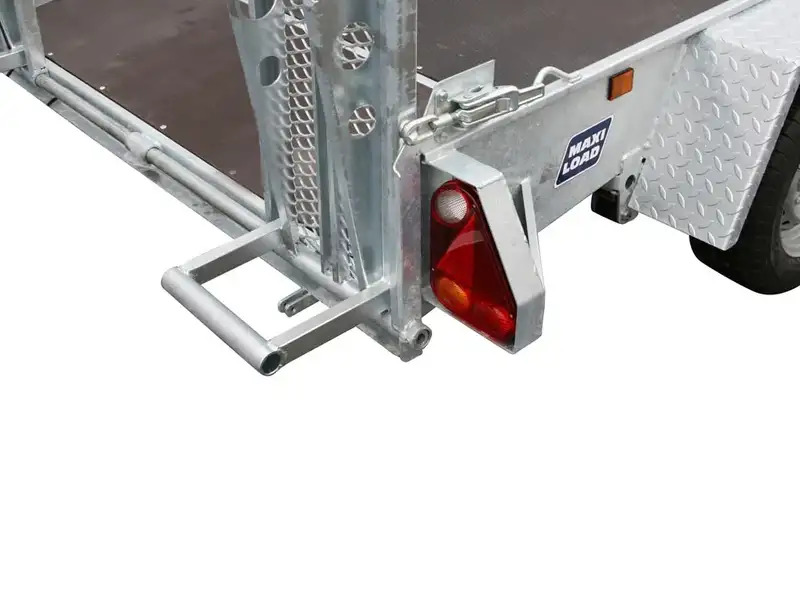
Plant trailers live in mud, on beaches, under wet spoil and behind vehicles throwing road salt. Hot dip galvanising coats the inside of box sections and the crevices around welds — the places that actually rot — in a way paint never does. On the published Variant plant trailers, hot dip galvanised chassis and sides are standard.234 If a trailer is painted, ask what happens at the weld heat-affected zones in five years.
Phenolic plywood decks
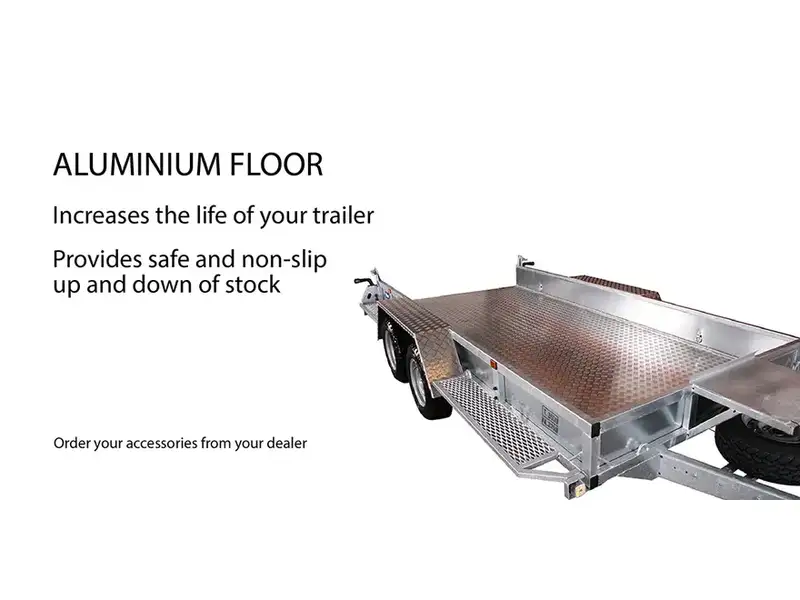
Phenolic-faced plywood at 18–21 mm, usually with anti-slip tread plate strips, is the European standard.234 It is lighter than steel checkerplate, does not sweat and rust, gives tracks decent grip, and when it eventually wears out you unbolt it and fit a new sheet. Steel decks are more durable against bucket teeth and easier to weld a fitting to — but they are heavier, slippery when wet, and once they corrode you are cutting and welding rather than unbolting.
An integrated lashing system
Welded D-rings put restraint points where the manufacturer guessed you would need them. A rail with sliding brackets puts them where your machine needs them. Since chain angle is what determines restraint effectiveness, being able to move the anchor 200 mm is worth real money. The 3518 B4 publishes four interior and ten exterior lashing hooks; the 3516 B3 an integrated securing rail.23
Sealed bearings and a rated spare
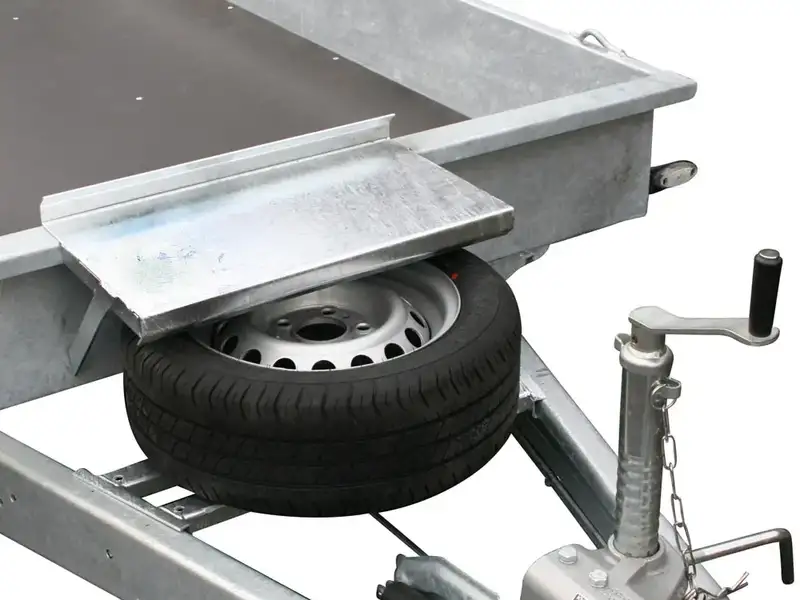
Ask whether the bearings are sealed, what the axle rating is against the trailer’s GTM, and whether a spare wheel of the correct stud pattern and load rating is included. These are cheap at purchase and expensive at the roadside.
The pre-purchase inspection
Read the compliance plate first. ATM, GTM and axle ratings. Everything the salesperson says is checked against this.
Calculate the payload yourself. ATM minus tare. Compare it to your machine’s operating weight plus attachments plus fuel. If the margin is under 100 kg, keep looking.
Measure the load height and ramp length. Work out the angle. Compare it to your machine’s belly clearance. This is the check that stops people buying a trailer their machine cannot climb.
Measure the deck. Your machine’s width plus 150 mm each side; your machine’s transport length plus 300 mm.
Push the drawbar in by hand. The damper should resist and return smoothly. Free movement means a dead damper.
Reverse it up a slope. Confirms the auto-reverse mechanism works.
Get underneath. Look at weld quality, spring condition, brake cable routing, and whether the galvanising actually got into the corners.
Count the rated lashing points and read their capacity markings. Unrated hooks are decoration.
Check the lights are sealed LED units and that the wiring is routed inside the chassis, not cable-tied along the outside where a track edge will find it.
Buying used
Plant trailers wear in predictable places. On a used trailer, prioritise:
- The deck. Cheap to replace on a bolted phenolic floor; a serious job on a corroded steel one.
- The coupling and damper. A worn overrun coupling is a rebuild or a replacement, and it is the single most-used component on the trailer.
- Brake shoes and cables. Seized cables are common on trailers that sat outside. Budget for a full brake service on any trailer with unknown history.
- Ramp hinges and gas struts. Struts fail with age and a full-width ramp without working struts is a two-person job.
- Corrosion at the axle mounts and spring hangers. Structural, and expensive.
- Tyre date codes. Almost every used trailer needs tyres, regardless of tread.
Ask for the compliance plate photo before you drive to see it. If the plate is missing or illegible, walk away — you cannot prove what it is rated to carry.
Ten questions worth asking any seller
- What is the tare weight, and is it plated or estimated?
- What is the payload after tare, exactly?
- What is the load height and the effective ramp length?
- Is the chassis hot dip galvanised, and were the sections galvanised after welding?
- What deck material, what thickness, and is it bolted or welded in?
- Overrun or electric brakes — and if overrun, is there auto-reverse?
- What is the axle rating, and are the bearings sealed?
- How many rated lashing points, at what capacity, and are they fixed or adjustable?
- Is a spare wheel included, and does it match?
- Where is the nearest place I can get brake and coupling parts?
The one that matters most. If a seller cannot give you the plated tare weight and the payload that follows from it, they are selling you a picture, not a trailer. Every other question is negotiable; that one is not.
Frequently asked questions
Are European plant trailers better than Australian ones?
They are optimised differently. European builds prioritise low tare weight and low load height, which maximises payload and produces shallower ramp angles inside a fixed 3,500 kg limit. Australian builds often prioritise ruggedness, simple repairability and regional parts availability. If your machine is near the payload ceiling, the European numbers win; if you run remote and want to weld your own repairs, the local approach has real merit.
How much should a 3.5 tonne plant trailer cost in Australia?
Prices move constantly, so compare on cost per kilogram of payload rather than sticker price: divide the price by the payload (ATM minus tare). That normalises trailers of different weights and quickly exposes a cheap trailer that cannot carry your machine. Always confirm current pricing directly with the seller.
Is hot dip galvanising worth paying for on a trailer?
On a plant trailer, yes. Galvanising coats the inside of box sections and the crevices around welds — exactly where corrosion starts and where paint does not reach. Plant trailers work in mud, spoil and salt, and the deck is regularly scraped by tracks. A painted trailer will usually look fine for three years and then start failing at the weld heat-affected zones.
Phenolic plywood or steel deck — which is better?
Phenolic plywood is lighter, gives tracks better grip, does not corrode, and unbolts for replacement when worn. Steel checkerplate resists bucket teeth better and lets you weld fittings on, but adds tare weight, is slippery when wet, and requires cutting and welding once it corrodes. For a trailer carrying tracked machinery, phenolic ply is the more practical choice.
What should I check when buying a used plant trailer?
Start with the compliance plate — if it is missing or illegible, walk away. Then check the deck condition, coupling and damper wear, brake shoes and cables for seizure, ramp hinges and gas struts, corrosion at axle mounts and spring hangers, and tyre date codes. Budget for a full brake service on any trailer with unknown history.
How do I compare two trailers fairly?
Reduce both to four numbers: payload (ATM minus plated tare), usable deck length and width, load height, and effective ramp length. Calculate each trailer's ramp angle from the last two. Then compare price per kilogram of payload. Those five figures settle most buying decisions faster than any feature list.
Can I fit an Australian tow vehicle to a European trailer without modifications?
Generally yes. European plant trailers sold in Australia are supplied with a 50 mm coupling, AS 4177 safety chains and Australian-compliant lighting, and mechanical overrun braking needs no in-cab controller at all. Confirm the trailer carries a compliance plate for Australian registration, and check the plug type matches your vehicle.
What is the most common mistake people make buying a plant trailer?
Buying on ATM instead of payload. A 3,500 kg trailer sounds like it carries 3,500 kg; after tare it carries 2,300–2,900 kg depending on build. The second most common mistake is ignoring ramp angle, then discovering the machine grounds out at the ramp-to-deck transition on the first load.
Sources and further reading
- Plant & Machinery Trailers range, Variant Trailers Australia — variant-trailers.com.au/category/trailers/plant-machinery-trailers/
- Beavertail Trailer 3518 B4 specification, Variant Trailers Australia — variant-trailers.com.au/trailers/beavertail-trailer-3518b4-4-08x1-88m/
- Beavertail machine trailer 3516 B3 specification, A2B Trailers — www.a2btrailers.com.au/trailers/3516b3/
- Tandem plant trailer 3518 M3 specification, A2B Trailers — www.a2btrailers.com.au/trailers/3518m3/
- Trailer brakes: electric versus quality mechanical overrun, A2B Trailers — www.a2btrailers.com.au/electric-vs-mechanical-trailer-brakes/
- Vehicle Standards Bulletin 1 (Revision 6) — Trailers with an Aggregate Trailer Mass of 4.5 tonnes or less, September 2024, Australian Government Department of Infrastructure — www.infrastructure.gov.au/sites/default/files/documents/vsb1-revision-6-traile
- Light Trailer Requirements — Compliance with VSB1, Department of State Growth Tasmania — www.transport.tas.gov.au/?a=109707
- Trailer and Tow Vehicle Specifications, RACQ — www.racq.com.au/car/towing/trailer-and-tow-vehicle-specifications
- Load Restraint Guide 2018 for Light Vehicles, National Transport Commission — www.ntc.gov.au/sites/default/files/assets/files/NTC%20Load%20Restraint%20Guide
Figures were checked against the sources above on 2026-08-26. Manufacturer specifications change without notice — confirm weights and dimensions against the current compliance plate and specification sheet before towing.