Loading and load restraint for plant trailers
The ramp geometry that decides whether your machine can get on, where to position it once it is there, and the restraint standard your chains legally have to meet.
The legal standard, stated plainly
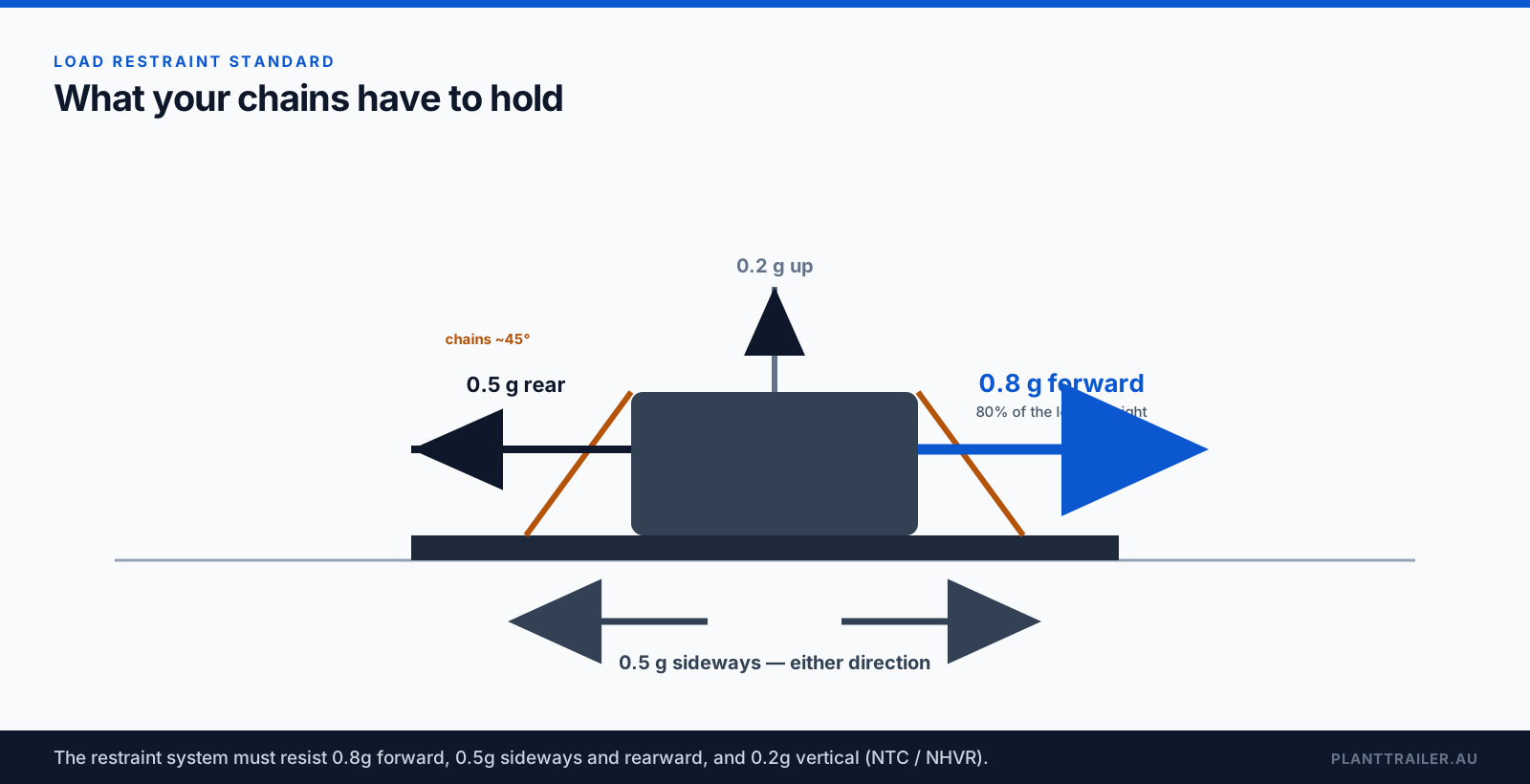
Your load restraint system must be able to withstand 0.8g (80% of the load’s weight) forward, 0.5g (50%) sideways and rearwards, and 0.2g (20%) vertically.1 Those numbers represent what a vehicle actually experiences under emergency braking, hard cornering and acceleration.
In practice, for a 2,500 kg machine, the restraint has to hold against 2,000 kg of forward force. That is why machinery is chained, not strapped.
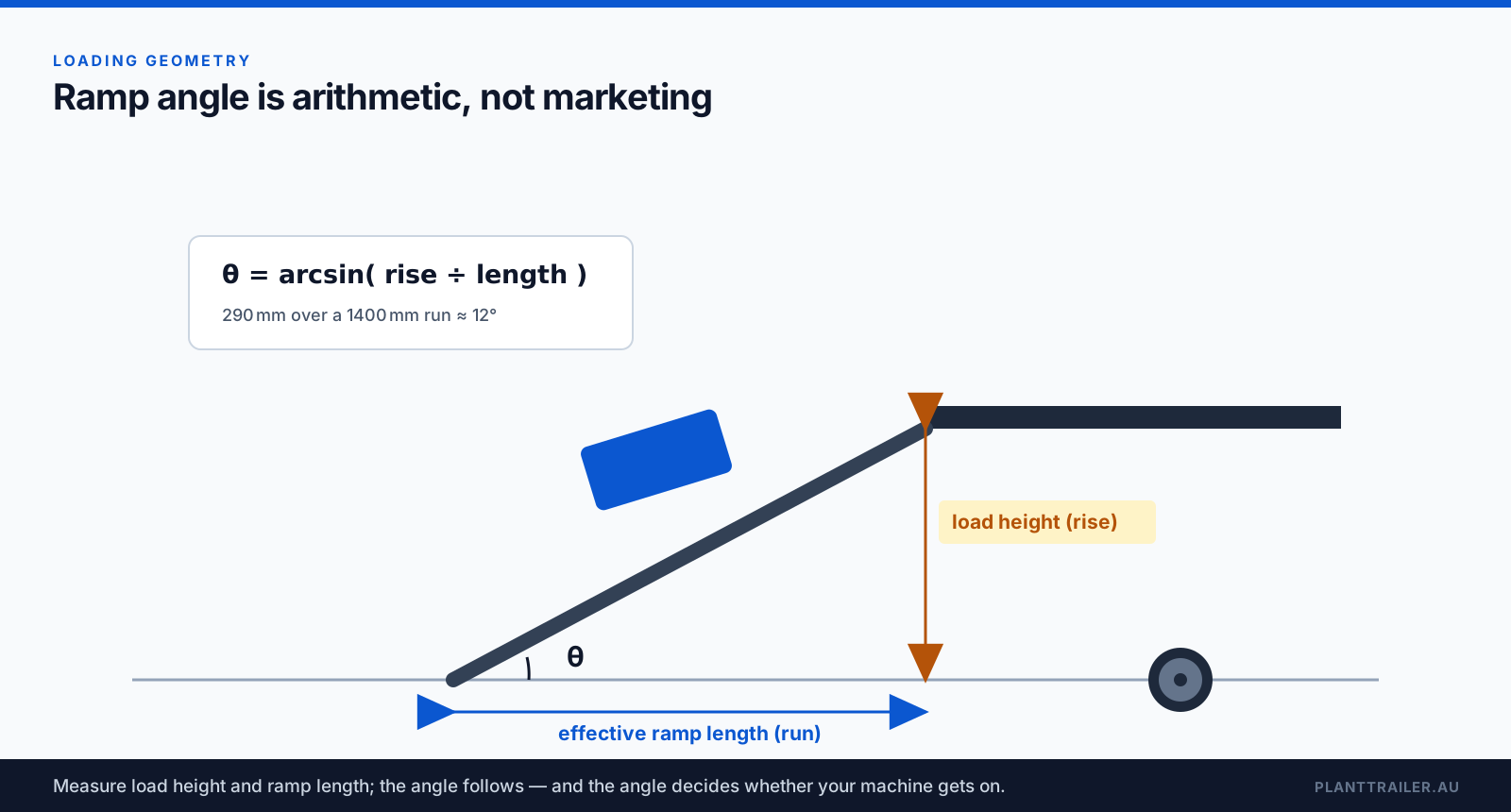
The ramp angle maths
Ramp angle is simple trigonometry: angle = arcsin(load height ÷ ramp length). That is worth knowing because it lets you check a manufacturer’s claim, or work out the angle of a trailer whose brochure does not state one.
Applying it to published Australian specifications reproduces the manufacturer’s stated figures almost exactly — a 290 mm load height over a 1,400 mm effective ramp gives 12°, a 330 mm height over 900 mm gives 22°, and a 380 mm height over 1,300 mm gives 17°.345 Measure your own trailer and you can do the same.
| Load height | 900 mm ramp | 1,200 mm ramp | 1,500 mm ramp | 1,800 mm ramp |
|---|---|---|---|---|
| 290 mm | 18.8° | 14.0° | 11.2° | 9.3° |
| 330 mm | 21.5° | 16.0° | 12.7° | 10.6° |
| 380 mm | 25.0° | 18.5° | 14.7° | 12.2° |
| 450 mm | 30.0° | 22.0° | 17.5° | 14.5° |
Green figures are comfortable for low-clearance machines such as scissor lifts and rollers. On a beavertail, the “effective ramp length” includes the tapered rear section of the deck — which is precisely why beavertails achieve angles a bolted-on ramp cannot.
The angle is not the whole story. Two other geometry traps catch machines that the ramp angle alone says will fit:
Breakover. Where the ramp meets the deck there is a ridge. A long machine with a low belly can bridge that ridge and lift its tracks off both surfaces. Beavertails and tilt beds largely eliminate this because there is no sharp transition.
Approach at the bottom. If the ground falls away behind the trailer, or you are parked on a crown, the real angle at the ramp foot is steeper than the specification. Always load on the flattest ground you can find, nose slightly uphill if you have a choice.
Where to put the machine on the deck
Position determines tow ball mass, and tow ball mass determines whether the combination is stable. Aim for roughly 8–12% of the loaded trailer mass on the ball — and check it against your tow vehicle’s maximum ball download, which is a separate limit set by the vehicle manufacturer and commonly around 10% of its towing capacity.6
- Too far back — light ball weight, and the trailer will sway. This is the dangerous failure, and it gets worse with speed, not better.
- Too far forward — excessive ball download, which unloads the tow vehicle’s front axle, degrades steering and braking, and may exceed the vehicle’s rating.
- The practical method — put the machine’s centre of mass slightly ahead of the axle group centreline, then measure the ball weight with a ball weight scale. Mark the position on the deck with paint so you can repeat it every time.
For an excavator, the centre of mass is not the middle of the machine — it sits toward the slew ring, and it moves when you swing the boom. Slew the boom to face forward and lower the bucket onto the deck before you measure.


Restraining the machine
Machinery is restrained by direct lashing — chains running from the machine’s rated tie-down points to the trailer’s rated lashing points, resisting movement directly — rather than by tie-down lashing, which relies on pressing the load into the deck to generate friction. Direct lashing is what a 2.5 tonne machine on a plywood deck requires.2
- Use rated components throughout. Chain, binders, shackles and the trailer’s own lashing points all carry a rating. The system is only as strong as its weakest link, and an unrated hardware-store chain has no place under a machine.
- Minimum four chains, one to each corner, pulling in opposing directions so the machine is boxed in front, rear and both sides.
- Aim for around 45° in both plan and elevation. A chain that is nearly vertical resists lift but almost nothing horizontal; a chain that is nearly flat does the opposite.
- Attach to the machine’s designated tie-down points — not to hydraulic lines, cylinder rods, steps, handrails or the blade edge. Manufacturers mark these points for a reason.
- Restrain attachments separately. A bucket resting in the bucket rest is not restrained. Chain it, or carry it in a secured box.
- Lower everything. Blade down on the deck, bucket down and curled in, boom in the transport position, outriggers retracted, mast lowered. A raised attachment is both a height hazard and a mass swinging on hydraulics.
- Park brake on, ignition off, key out. Track locks engaged where fitted.
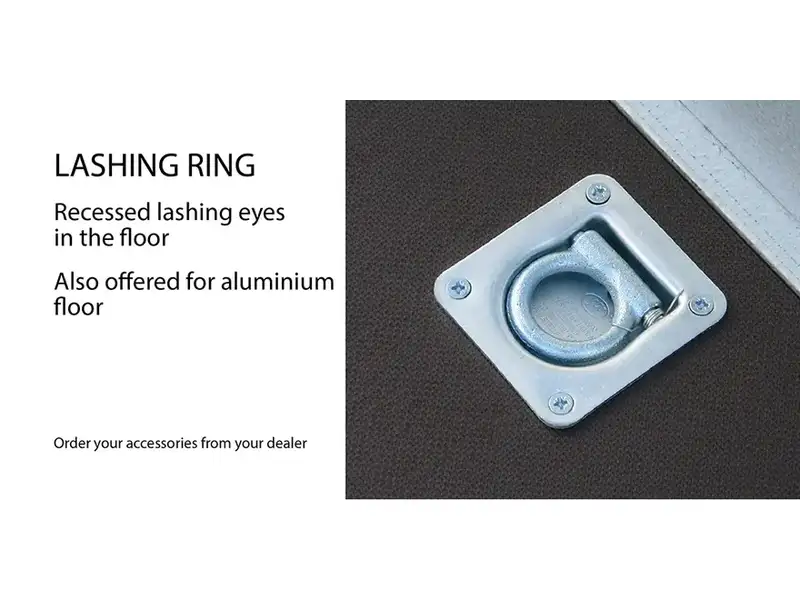
The published Variant plant trailers illustrate what a properly equipped deck looks like: the 3518 B4 lists four interior and ten exterior lashing hooks, and the 3516 B3 an integrated load securing rail with sliding brackets.34 The more rated points you have, the more freedom you have to get the angles right rather than settling for whatever the chain will reach.
A loading procedure that works every time
Before — Park on the flattest ground available, tow vehicle in gear or park, handbrake on, wheels chocked. Trailer handbrake on. Check the deck is clear and dry; wet phenolic plywood with mud on it is very slippery.
Ramps — Deploy and confirm both ramps are fully seated and locked. Set split ramps to the machine’s exact track width. Never load with the trailer still coupled to a vehicle that is not secured.
Approach — Line the machine up square, well back, and correct the alignment before you reach the ramps rather than on them. Spotter positioned to the side, in the operator’s view, never behind or beside the ramps.
Track on — Slow, steady, no steering corrections on the ramp itself. Tracked machines should climb with the heavy end — usually the counterweight — leading, so the machine stays balanced as it crests.
Position — Move to your marked position, slew the boom forward, lower everything onto the deck, park brake on, shut down, remove the key.
Restrain — Four chains minimum, opposing directions, roughly 45°, to rated points, tensioned with binders. Restrain attachments separately.
Final walk-around — Ramps stowed and pinned. Coupling latched and secondary device engaged. Chains crossed. Breakaway attached to the tow bar. Lights working. Tyre pressures. Nothing loose on the deck. Check the ball weight if the load position changed.
After 20 minutes of driving — Pull over and re-check chain tension. Loads settle, and chains that were tight in the yard are often loose on the highway.
The mistakes that cause incidents
- Loading on a slope. Adds several degrees to the real ramp angle and can pitch a machine over sideways.
- Spotter behind the trailer. If the machine slips off a ramp, that is exactly where it goes.
- Straps instead of chains. Webbing is for materials. Machinery moves against sharp steel edges.
- Chaining to the blade or handrails. Those are not rated tie-down points and can fail or bend.
- Forgetting the bucket. An unrestrained 90 kg bucket in a 0.8g stop is a 72 kg forward force looking for somewhere to go.
- Never re-checking tension. Every load settles in the first half hour.
- Not knowing the ball weight. The single most common cause of trailer sway is a tail-heavy load.
Frequently asked questions
What is the load restraint standard in Australia?
A restraint system must withstand 0.8g — 80% of the load's weight — in the forward direction, 0.5g sideways and rearwards, and 0.2g vertically. For a 2,500 kg machine that means resisting 2,000 kg of forward force, which is why machinery is restrained with rated chain and binders rather than webbing straps.
How do I calculate a trailer's ramp angle?
Angle equals arcsin of load height divided by effective ramp length. A 380 mm load height over a 1,300 mm ramp gives 17°; a 290 mm load height over a 1,400 mm effective ramp gives 12°. On a beavertail the effective length includes the tapered rear section of the deck, not just the fold-out ramp.
How many chains do I need to secure an excavator?
A minimum of four, one to each corner, pulling in opposing directions so the machine is restrained forward, rearward and both sides. Aim for roughly 45° in both plan and elevation, attach only to the machine's designated tie-down points, and restrain buckets and attachments separately.
What tow ball weight should a loaded plant trailer have?
Roughly 8–12% of the loaded trailer mass, and never more than the tow vehicle's maximum ball download. Too little and the trailer will sway at speed; too much and it unloads the tow vehicle's front axle. Position the machine slightly ahead of the axle group centreline, measure with a ball weight scale, then mark the deck so you can repeat it.
Can I use ratchet straps instead of chains for machinery?
Not for a tracked or heavy wheeled machine. Webbing is designed for materials with smooth contact surfaces; machinery has sharp steel edges that cut webbing, and the forces involved at 0.8g exceed what practical strap assemblies deliver. Use rated chain with load binders to the machine's designated tie-down points.
Do I need to restrain the bucket separately?
Yes. A bucket sitting in a bucket rest is carried, not restrained. Under emergency braking it will move. Either chain it down independently or transport it in a secured toolbox. The same applies to breakers, augers, trenching attachments and any spare parts on the deck.
Should I re-check the chains during the trip?
Yes — pull over after about 20 minutes and re-tension. Loads settle as the suspension works and the machine's tracks bed into the deck, so chains that were correctly tensioned in the yard are commonly loose by the time you reach the highway. Check again after any long descent.
Sources and further reading
- Loading Guide — Performance Standards, National Heavy Vehicle Regulator — www.nhvr.gov.au/road-access/loading/loading-guides/performance-standards
- Load Restraint Guide 2018 for Light Vehicles, National Transport Commission — www.ntc.gov.au/sites/default/files/assets/files/NTC%20Load%20Restraint%20Guide
- Beavertail Trailer 3518 B4 specification, Variant Trailers Australia — variant-trailers.com.au/trailers/beavertail-trailer-3518b4-4-08x1-88m/
- Beavertail machine trailer 3516 B3 specification, A2B Trailers — www.a2btrailers.com.au/trailers/3516b3/
- Tandem plant trailer 3518 M3 specification, A2B Trailers — www.a2btrailers.com.au/trailers/3518m3/
- Trailer and Tow Vehicle Specifications, RACQ — www.racq.com.au/car/towing/trailer-and-tow-vehicle-specifications
- Kubota U27-4 mini excavator specifications, Kubota Australia — kubota.com.au/product/excavator-u27-4
- Vehicle Standards Bulletin 1 (Revision 6) — Trailers with an Aggregate Trailer Mass of 4.5 tonnes or less, September 2024, Australian Government Department of Infrastructure — www.infrastructure.gov.au/sites/default/files/documents/vsb1-revision-6-traile
Figures were checked against the sources above on 2026-08-26. Manufacturer specifications change without notice — confirm weights and dimensions against the current compliance plate and specification sheet before towing.