What machinery fits on a plant trailer under 3.5 tonnes?
Published operating weights, widths and lengths for the machines Australians actually tow — matched against real trailer payloads and deck sizes, so you can check your machine before you buy the trailer.
Three numbers decide whether a machine fits
1. Operating weight vs payload. The machine as you tow it — attachments, full fuel, toolbox — must be under the trailer’s payload, which is ATM minus tare. On a 3,500 kg trailer that is typically 2,700–2,900 kg.8910
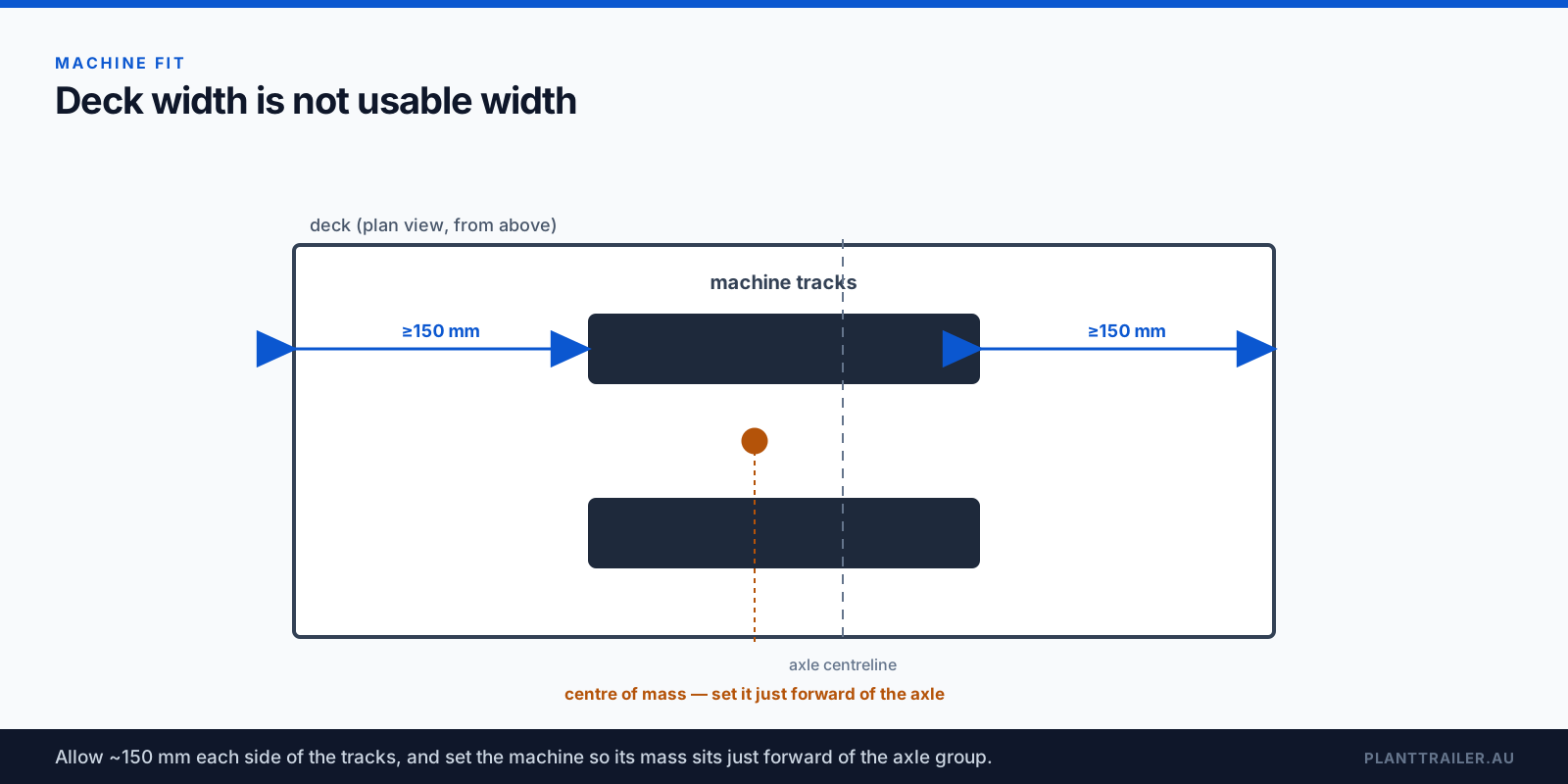
2. Track or wheel width vs deck width. Add roughly 150 mm each side for safe positioning. A 1,500 mm wide machine wants a 1,800 mm deck.
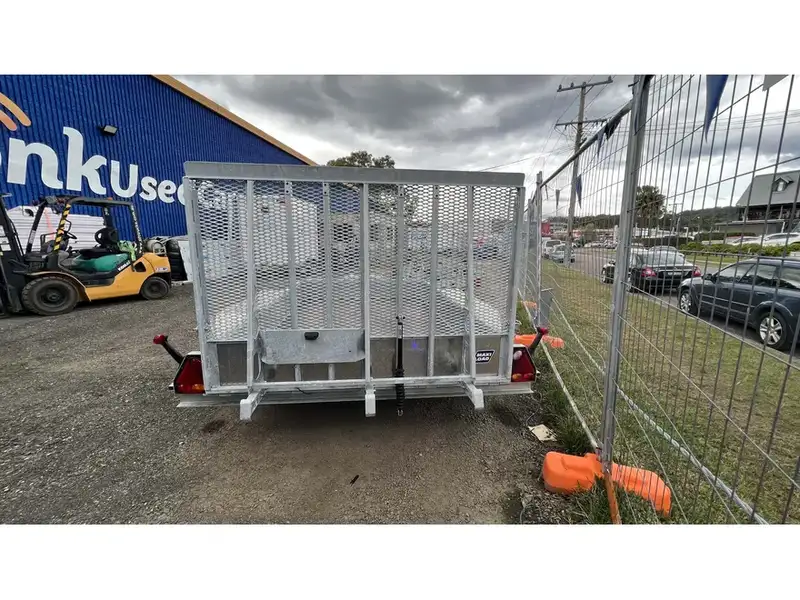
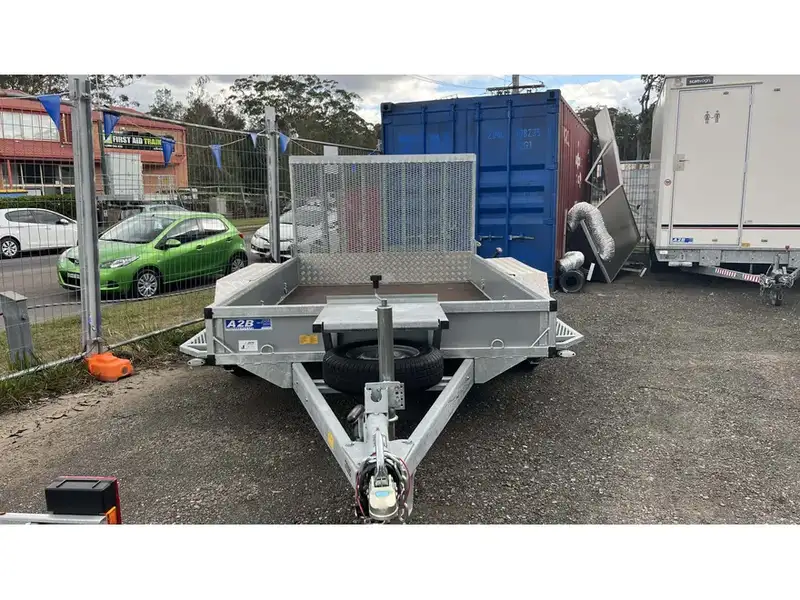
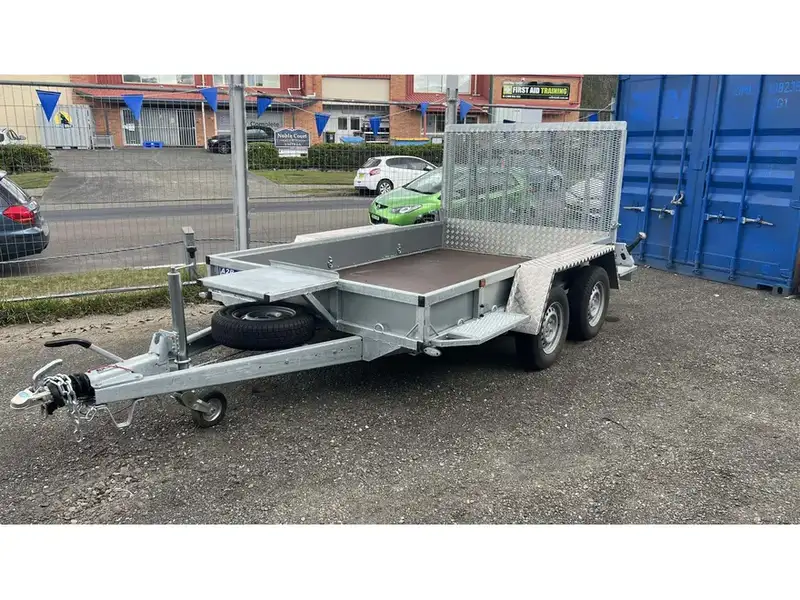
3. Belly clearance vs ramp angle. Low-clearance machines need a beavertail; the ramp angle, not the payload, is what usually stops a machine getting on.




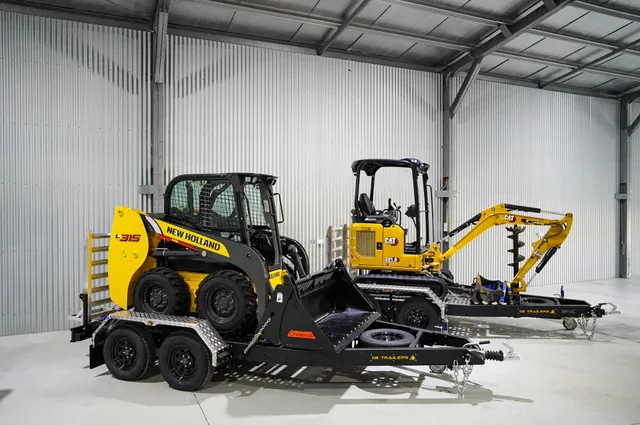
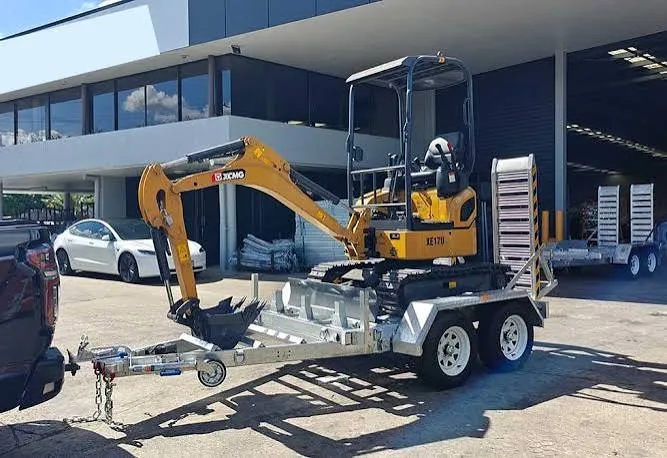
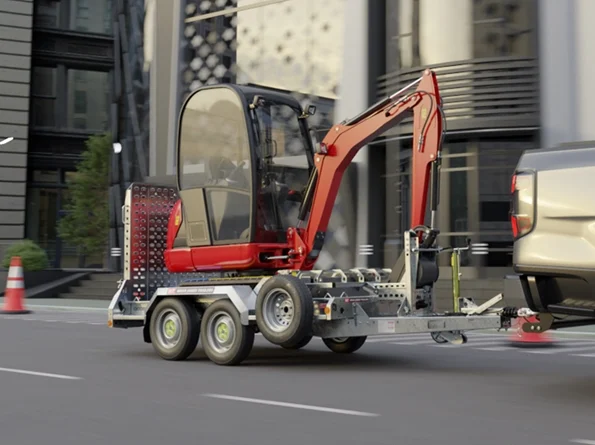
Mini excavators
The most common plant trailer load in Australia, and the one where the margin is tightest. Operating weight climbs quickly with machine size, and the canopy-versus-cab choice alone can move it by a hundred kilograms or more. Work from your machine’s actual specification sheet, not the class name.
| Machine | Operating weight | Width | Transport length | Height | 3.5t trailer? |
|---|---|---|---|---|---|
| Kubota U17-3 (canopy) | 1,675 kg1 | 990–1,240 mm | 3,545 mm | 2,340 mm | Comfortable |
| Kubota U27-4 (canopy) | 2,570 kg2 | 1,500 mm | 4,100 mm | 2,420 mm | Yes — needs a 4 m deck |
| 1–2 t class (general) | 900–2,050 kg7 | 710–1,300 mm | — | — | Comfortable |
| 2–3 t class (general) | 2,050–2,950 kg7 | 990–1,550 mm | — | — | Check the exact model |
| 3–5 t class (general) | 2,950–5,000 kg7 | 1,500–2,000 mm | — | — | Generally no |
The 3 tonne trap. A machine advertised as a “3 tonne excavator” is a class name, not a weight. Many are 3,200–3,600 kg with a cab and a steel track, which puts them over the payload of every 3,500 kg trailer before you add a bucket. If you own a 3 tonne machine, you are almost certainly looking at a trailer above the light-trailer category — and a heavier licence and tow vehicle with it.
Skid steers and compact track loaders
Skid steers are short and dense, which makes them easy to position over the axles but means weight adds up faster than the machine’s size suggests. Compact track loaders are heavier again for the same bucket capacity, and wider — deck width is often the limiting factor rather than payload.
| Machine | Operating weight | Width | Length | Rated capacity | 3.5t trailer? |
|---|---|---|---|---|---|
| Bobcat S70 | 1,312 kg3 | ~914 mm | — | 362 kg | Very comfortable |
| Bobcat S450 | 2,280 kg4 | 1,490 mm | 3,180 mm | 590 kg | Yes |
| Mid-size skid steer (general) | 2,700–3,600 kg | 1,600–1,800 mm | — | — | Marginal to no |
| Compact track loader (general) | 3,000–4,500 kg | 1,600–2,000 mm | — | — | Generally no |
Scissor lifts and elevating work platforms
Electric slab scissor lifts are a natural plant trailer load: narrow, self-propelled and well under the payload. The catch is geometry rather than weight. They are long, sit very low, and have small solid wheels with almost no ground clearance — which makes ramp angle the whole conversation. A scissor lift that grounds out on a 20° ramp will drive straight onto a 12° beavertail.
| Machine | Weight | Width | Length | Working height | Notes |
|---|---|---|---|---|---|
| Genie GS-1930 (19 ft) | 1,226 kg5 | ~760 mm | — | ~7.8 m | Easy load; very low clearance |
| Genie GS-2632 (26 ft) | 2,145 kg6 | 810 mm | 2,440 mm | 9.96 m | Fits payload easily; needs shallow ramp |
Mini loaders, rollers and compaction
Stand-on mini loaders (the Kanga and Dingo class) are the lightest machine most operators tow, commonly in the 500–1,200 kg range. Payload is never the issue — but attachments are. A trencher, auger set, four-in-one bucket and a pallet of pipe can add more weight than the machine itself, and they all count.
Ride-on rollers are dense and low. A twin-drum roller concentrates its mass over two narrow steel drums, which is hard on a plywood deck and demands proper spreading, and the drums give essentially zero approach clearance. Rollers are the classic case for a beavertail.
Plate compactors, mixers, generators and light towers are usually incidental weight, but check whether you are already near payload with the main machine before you add them.
What does not fit under 3.5 tonnes
- Telehandlers. Even compact models are typically 4,500–7,000 kg. Not a light-trailer load.
- 5 tonne class excavators. Around 4,800–5,500 kg operating weight7 — over the ATM of the whole trailer, let alone the payload.
- Mid-size skid steers and most compact track loaders. The bucket capacity is tempting; the weight is not.
- Backhoes and tractors above about 2.5 tonnes with a loader fitted. Loader arms and a rear implement move the figure quickly.
The attachment arithmetic nobody does. Take a 2,570 kg U27-4 on a trailer with 2,715 kg of payload. That is 145 kg of headroom. A 450 mm trenching bucket, a mud bucket, a hydraulic breaker and a set of chains will eat that and more. Either tow the attachments separately, or buy the trailer with the higher payload. Weigh the loaded combination at a public weighbridge once — it settles the argument permanently.
Matching machine to deck
| Deck | Suits machine width up to | Suits transport length up to | Typical published payload |
|---|---|---|---|
| 3.00 × 1.62 m (3516 B3) | ~1,320 mm | ~2,700 mm | 2,907 kg9 |
| 3.00 × 1.80 m (3518 M3) | ~1,500 mm | ~2,700 mm | 2,770 kg10 |
| 4.00 × 1.80 m (3518 B4) | ~1,500 mm | ~3,700 mm | 2,715 kg8 |
Machine width and length columns apply the 150 mm-per-side clearance and 300 mm length allowance described above to the published deck dimensions. Payloads are manufacturer figures.
Frequently asked questions
Can I tow a 3 tonne excavator on a 3.5 tonne trailer?
Almost never. A 3.5 t trailer has a payload of roughly 2,700–2,900 kg once its own tare is subtracted, and machines sold as “3 tonne” commonly weigh 3,200–3,600 kg in working trim. The machine has to fit inside the payload, not inside the ATM. Check the machine's compliance plate rather than its class name.
What size mini excavator can I tow on a car licence?
Up to roughly 2.8 tonnes operating weight, assuming a trailer with about 2,900 kg of payload and no heavy attachments. A Kubota U27-4 at 2,570 kg is a realistic upper limit with margin for a bucket and chains. A 1.7 t class machine such as the U17-3 at 1,675 kg leaves plenty of room.
How much clearance do I need each side of the machine on the deck?
About 150 mm per side as a working minimum. That gives room to correct alignment while driving on, space for chains and binders to sit without fouling the tracks, and tolerance for a machine that is not perfectly straight. A 1,500 mm wide machine therefore wants a deck of at least 1,800 mm.
Do attachments and fuel count toward the payload?
Yes. Payload is everything on the trailer: the machine, a full fuel tank, every bucket, breaker or auger, the chains and binders, and any toolbox. A set of attachments can easily add 150–300 kg, which is more than the spare capacity on a tight combination. Weigh the loaded trailer at a public weighbridge to know for certain.
Can a scissor lift go on a plant trailer?
Yes, and weight is rarely the problem — a 26 ft Genie GS-2632 is 2,145 kg, well within payload. The problem is geometry: scissor lifts have small solid wheels and almost no ground clearance, so they bottom out on steep ramps. Use a beavertail or low loader with a shallow angle, and check the transition from ramp to deck as well as the ramp itself.
Will a telehandler fit on a 3.5 tonne trailer?
No. Even compact telehandlers start around 4,500 kg, which exceeds the entire ATM of a light trailer, not just its payload. Moving a telehandler means a heavier trailer, a heavier tow vehicle and, in most states, an upgraded licence class.
How do I position the machine on the deck?
Slightly forward of the axle centreline, so that roughly 8–12% of the loaded trailer mass sits on the tow ball. Too far back and the trailer becomes tail-heavy and prone to sway; too far forward and you exceed the tow vehicle's maximum ball download. Move the machine, then check the ball weight — do not guess.
Sources and further reading
- Kubota U17-3 mini excavator specifications, Kubota Australia — kubota.com.au/product/excavator-u17-3
- Kubota U27-4 mini excavator specifications, Kubota Australia — kubota.com.au/product/excavator-u27-4
- Bobcat S70 skid-steer loader specifications, Doosan Bobcat Oceania — www.bobcat.com/oc/en/equipment/loaders/skid-steer-loaders/s70
- Bobcat S450 skid steer loader specifications, RitchieSpecs — www.ritchiespecs.com/model/bobcat-s450-skid-steer-loader
- Genie GS-1930 scissor lift specifications, RitchieSpecs — www.ritchiespecs.com/model/genie-gs1930-scissor-lift
- Genie GS-2632 E-Drive scissor lift specifications, Genie — www.genielift.com/en/aerial-lifts/Slab-scissor-lifts/gs2632
- Mini Excavator Weight, Size and Dimensions Guide, DOZR — dozr.com/blog/mini-excavator-spec-guide
- Beavertail Trailer 3518 B4 specification, Variant Trailers Australia — variant-trailers.com.au/trailers/beavertail-trailer-3518b4-4-08x1-88m/
- Beavertail machine trailer 3516 B3 specification, A2B Trailers — www.a2btrailers.com.au/trailers/3516b3/
- Tandem plant trailer 3518 M3 specification, A2B Trailers — www.a2btrailers.com.au/trailers/3518m3/
- Trailer and Tow Vehicle Specifications, RACQ — www.racq.com.au/car/towing/trailer-and-tow-vehicle-specifications
Figures were checked against the sources above on 2026-08-26. Manufacturer specifications change without notice — confirm weights and dimensions against the current compliance plate and specification sheet before towing.